Why Your Business Falls Apart When You're Not There (and Where to Start Fixing It)
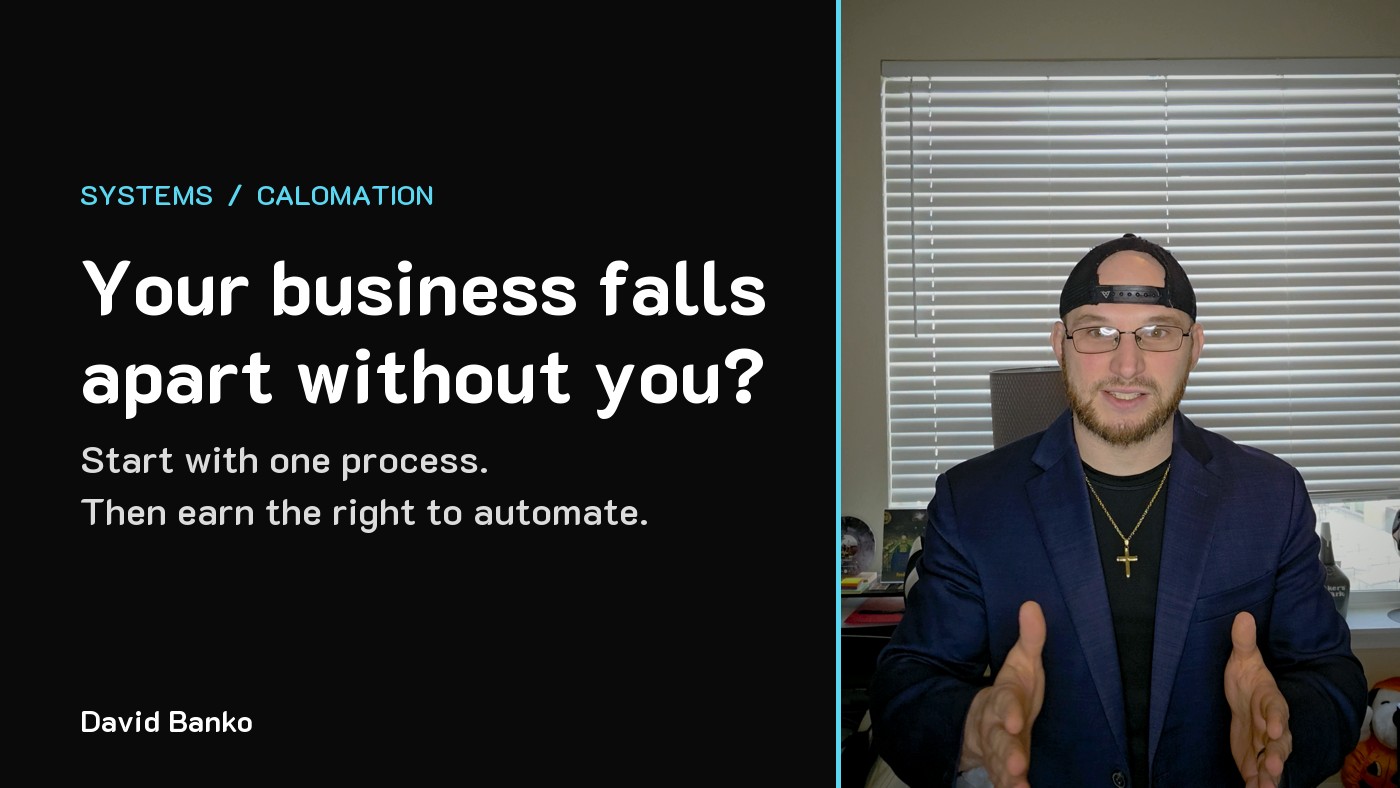
A founder told me recently that he's running around all day. Phone calls, text messages, questions from his team and from his clients, all day long.
His business is doing great work. It's growing. It's profitable. But at the end of the day, most decisions still fall back on him.
That's not a scalable or sustainable business model. And it's one of the most common things I hear from owners. So let's take the five questions I get asked most about it, one at a time.
Why does my business fall apart when I'm not there?
Because you built a business that does great work, but you're still the one who makes every call.
The fix is to start writing down how you make those decisions. When a call comes in, what's being said? What do you think about? What do you consider? What information do you need, and how do you get from that information to an answer?
Write it down. Talk it through. Take a voice note. Slowly, over time, those notes become your SOPs: here's what happens in this situation, here's the information I need, here's what I consider, and here's who needs to be involved or told.
Once it's written down, you can share it with your team. Now it's not all on you. Somebody else knows what information is needed, what goes into the decision, and what needs to happen once the decision is made.
Why haven't all the apps I've bought fixed anything?
Every time I tell someone I use AI in my day-to-day work, it never fails. "Have you tried this new tool? Have you seen this new software?"
There's a new one every day. Nobody can keep up with all of them, let alone figure out how to put each one to work in their business.
So we get distracted by the shiny object. This is going to fix my business. This is going to fix the problem I'm facing. We start a free trial, and then we don't do anything with it. It becomes one more thing on the to-do list.
The apps didn't work because the foundation wasn't built first. What are your internal processes? What has to happen, every time, for the work to get done?
Once those processes are laid out, you can start looking at tools. That's how you earn the right to automate. You don't need all those different apps anymore, because now you know exactly which one fixes your problem, and you put it to work on one specific part of the process.
What does an organized business actually look like?
To me, an organized business has its documents and processes in place. Everyone knows what happens, for every role on the team.
Every person knows their role and their responsibilities. It's all laid out. Everything is documented. And if one person needs to step in for someone else one day, they can, and they know exactly what to do.
As an owner and founder, you should be able to walk away. Take a day off, take a vacation, and not worry about it, because the tools, the systems and the people are in place to run it.
It's not dependent on you. You're not the single point of failure. That's what organized looks like.
Is a real system worth it for a small business?
Yes, it is worth it. But we as owners have to earn the right to automate.
When we talk about systems and automating parts of a process, we first have to know what each step of that process is. Where can it be automated, and where do we still need a person?
That means doing the work and building the foundation. Run the process yourself, over and over, until you know every step, what done right looks like, and where the gaps are.
Then, when you bring in a system, a tool, a piece of software or an automation, you know exactly what it has to look like. You can put the right things in place because you've done it yourself.
Businesses need systems in order to scale. So yes, it's worth it. You just have to do the groundwork to build it up.
Where do I start if my business is a mess?
This one comes up a lot. There are no processes in place. Every day feels like putting out fires. You can't plan your day, because you know something is going to need your attention.
So where do you start? With one thing. One simple, small thing.
Regardless of the fires, what's something you know you'll do every single day? Start there.
Maybe it's the calls where people want to talk to the owner. When you make those calls, record them. Get the transcripts. Write down the common questions, the information that usually comes in, how you think it through, how you answer, and what you do after the call.
You're doing it every day anyway. Document it over and over, and that becomes your documentation. Now somebody else on your team can start handling those calls. That's one process off your plate, and your customers get their answers faster.
Start with one. Once you finish one, go to the second, and that's how it starts to grow.
The short version
If your business can't run without you, you don't need another app. Write down how you make decisions, one process at a time, starting with the thing you do every day. Earn the right to automate, then bring in the tools.
If you'd like help figuring out which process to hand off first, book 20 minutes with me.
Want to see where your business is leaking leads?
Take the two-minute diagnosis, or book 20 minutes with David. We look at your business together. No pitch.
Book a 20-Minute CallTake the Diagnosis